Deep Survival
By Laurence Gonzales
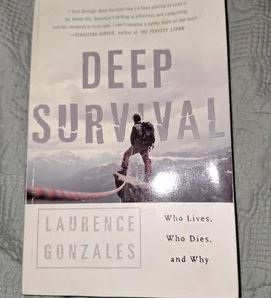
As I have throughout the years, adventuring and traveling in remote and wild places lends itself to things not going as planned with a possible battle for survival as an outcome. Thus far, my luck has held and other than running out of food a couple of times or waiting for a storm to subside, I have not had to enter the survival arena. This book was a great read portraying the traits and skills that survivors have to make it through unthinkable situations. The knowledge in this book is transferable to our everyday lives whether it be overcoming a job loss, a break-up, or catastrophe caused by Mother Nature. It is worth the read.
A Few of my favorite Excerpts…
It is not a lack of fear that separates elite performers from the rest of us. They’re afraid, too, but they’re not overwhelmed by it. They use it to focus on taking correct action.
As complex as the brain is, the world is more so. The brain cannot process and organize all the data that arrive. It cannot come up with a reasonable course of action if everything is given equal weight and perceived at equal intensity. That is the difficulty with logic: It’s step-by-step linear. The world is not.
“In the face of uncertainty,” Charles Perrow writes, “we must, of course, make a judgement, even if only a tentative and temporary one. Making a judgement means we create a ‘mental model’ of an expected universe…You are actually creating a world that is congruent with your interpretation, even though it may be the wrong world.”
Perrow’s book was even more controversial because he found that efforts to make those systems safer, especially by technological means, made the systems more complex and therefore more prone to accidents. In system accidents, unexpected interactions of forces and components arise naturally out of the complexity of the system.
Researchers point out that people tend to take any information as confirmation of their mental models.
If you find yourself in enough trouble to be staring death in the face, you’ve gotten there by a well-worn path.
Heraclitus said that every time you step into the river, it’s a different river. Every time you walk on Mount Hood, it’s a different mountain. To use the technical terms, it’s a boundary condition, a phase transition zone.
Al Siebert, a psychologist, writes in The Survivor Personality that the survivor (a category including people who avoid accidents) “does not impose pre-existing patterns on new information, but rather allows new information to reshape his mental models.
Chance is nothing more than opportunity, and it is all around at every turn; the trick lies in recognizing it.
Plan the flight and fly the plan. But don’t fall in love with the plan. Be open to a changing world and let go of the plan when necessary so that you can make a new plan. Then, as the world and the plan both go through their book of changes, you will always be ready to do the next right thing.
He saw that to lose everything at the edge of such a glorious eternity is far sweeter than to win by plodding through a cautious, painless, and featureless life.
Survivors always turn a bad situation into an advantage or at least an opportunity…Sure, it takes luck to be a survivor, and luck is nothing more than the accumulation of circumstance throughout a life.
The Rules of Adventure:
· Perceive, believe, then act
· Avoid impulsive behavior; don’t hurry
· Know your stuff
· Get the information
· Commune with the dead – read accident reports
· Be Humble
· When in doubt, bail out
· Stay calm (use humor, use fear to focus)
· Think/analyze/plan (get organized; set up small, manageable tasks)
· Take correct, decisive action (be bold and cautious while carrying out tasks)
· Celebrate your successes (take joy in completing tasks)
· Count your blessings (be grateful you’re alive)
· Play (sing, play mind games, recite poetry, count anything, do mathematical problems in your head)
· See the beauty (remember, it’s a vision quest)
· Believe that you will succeed (develop a deep conviction that you will survive)
· Surrender (let go of your fear of dying; “put away the pain”)
· Do whatever is necessary (be determined; have the will and the skill)
· Never give up (let nothing break your spirit)
We can live a life of bored caution and die of cancer. Better to take the adventure, minimize the risks, get the information, and then go forward in the knowledge that we’ve done everything we can.