The Comfort Crisis
By Michael Easter
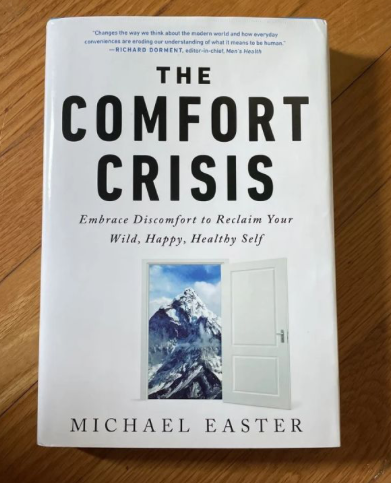
I recently read this book after having it on my reading list for years. I’m not sure why it took me so long, but it is a great read with its message resonating with how I strive to live my life. For those who follow this website, you know that I am always on the hunt to find ways to push myself out of my comfort zone. Most of this involves thinking up and attempting wild and wacky adventures in remote places. But it also includes taking risks and pushing myself professionally and in my personal life. Michael’s research confirms what I believe to be true - that our lives become more rich and meaningful when we intentionally seek out ways to make ourselves uncomfortable. Enjoy the read - I did!
a few of my favorite excerpts…
“If you want to have amazing experiences,” he said as we wove up the trail, the silhouette of towering pines black against the moonlit navy sky,
“you have to put yourself in amazing places.”
– Donnie Vincent
Misogi is not about physical accomplishment,” said (Nelson) Parrish. “It asks, ‘What are you mentally and spiritually willing to put yourself through to be a better human?’ Misogis have allowed me to let go of fear and anxiousness, and you can see that in my work.
Lapsing into flow requires two conditions: The task must stretch a person’s limits and it must have a clear goal. The flow state, Csikszentmihalyi and the other researchers now believe, is a key driver of happiness and growth. It is the opposite of apathy. Csikszentmihalyi wrote that flow has the “potential to make life more rich, intense, and meaningful; it is good because it increases the strengths and complexity of the self.”
Scientists in the United Kingdom recently found that our brain has a trancelike “autopilot” or “sleepwalking” mode. Once we’ve done something over and over, our mind zones out of whatever old thing it’s doing. Instead of being present and aware, we’re far more likely to be lost somewhere inside our noggin. We’re planning what we’ll eat for dinner, wondering when the new season of that one show comes out, speculating about our office frenemy’s salary. We live in a state of constant mental churn and meaningless chatter. My months of preparation changed much of that. New situations kill the mental clutter. In newness we’re forced into presence and focus. This is because we can’t anticipate what to expect and how to respond, breaking the trance that leads to life in fast forward. Newness can even slow down our sense of time. This explains why time seemed slower when we were kids. Everything was new then and we were constantly learning.
The average American each day touches his phone 2,617 times and spends 2 hours and 30 minutes staring at the small screen.
A rule: If you’re not paying for a digital service, YOU are what the company sells. The corporation games the system to take as much of your attention as it can in order to sell it to the highest advertorial bidder.
(Aaron) Sorkin’s takeaway is that we should learn to deal with boredom and then discover ways to overcome it that are more productive and creative than watching a YouTube video or scrolling through Instagram.
Most Americans are unaware of how good you have it, and so, many of you are miserable and chasing the wrong things,” he said. “What are these wrong things?” I asked, looking for the pose and tone one should take when speaking to a religious authority. “You act like life is fulfilling a checklist. ‘I need to get a good wife or husband, then I get a good car, then I get a good house, then I get a promotion, then I get a better car and a better house and I make a name for myself and then…’ ” He rattled off more accomplishments that fulfill the American Dream. “But this plan will never materialize perfectly. And even if it does, then what? You don’t settle, you add more items to the checklist. It is the nature of desire to get one thing and immediately want the next thing, and this cycle of accomplishment and acquisitions won’t necessarily make you happy—if you have ten pairs of shoes you want eleven pairs.
He’s not wrong. Stuff collection has increased in the United States over the last 100 years. The average American woman in the 1930s, for example, had 36 clothing items in her closet. People today who consulted a decluttering service were found to have 120, and most of them were rarely worn. According to scientists at the University of California-Riverside, material goods fall prey to a similar “creep” phenomenon. They give us a burst of cheer. That is, until we’ve had them for a moment, which is when we lose interest and the next material desire consumes our mind.
Researchers at San Francisco State University found that titles, wealth, and possessions ultimately improve our well-being only insofar as they fulfill our basic needs. For example, having enough money to buy a safe home, sufficient food, and a car that works might increase our happiness. But there isn’t much long-term difference in the well-being one gets from, say, living in a modest home versus a McMansion or commuting in a base-model Mazda versus a Maserati. The researchers, in fact, found a paradox: being overly materialistic leads to unhappiness.
The Tibetan Book of Living and Dying, calls this checklist phenomenon “Western laziness.” It consists of “cramming our lives with compulsive activity, so that there is no time at all to confront the real issues….If we look into our lives, we will see clearly how many unimportant tasks, so-called ‘responsibilities’ accumulate to fill them up….Going on as we do, obsessively trying to improve our conditions, can become an end in itself and a pointless distraction.”
The lasting shifts in happiness I’ve experienced haven’t come from anything societally imposed. Not money, degrees, titles, jobs, stuff. They’ve come from shifts in my mental state.
When people come into my hospital there is a chance they leave,” he said. “But there is also a high chance they do not leave. My job is to help people prepare for death. I have found that the people who have not thought about death are the ones who have regrets on their deathbeds, because they have not used a necessary tool that could have made them live a fuller life.” An American study conducted across various hospitals like the Yale Cancer Center, Dana-Farber Cancer Institute, and Massachusetts General Hospital supports this notion. It found that dying patients who had open conversations about their death experienced a better quality of life in the weeks and months leading to their passing, as judged by their family members and nurse practitioners.
The mind is afflicted with many delusions. But they come down to three,” continued the lama. “And those are greed, anger, and ignorance. When your mind is not taken care of, these three things have an advantage. The dying people I counsel…they suddenly do not care about getting famous, or their car or watch, or working more. They don’t care about the things that once angered them.” In other words: When a person realizes death is imminent, their checklist and everyday bullshit becomes irrelevant and their mind begins to center on that which makes it happy. Research from Australia found that the top regrets of the dying include not living in the moment, working too often, and living a life the person thinks they should rather than one they truly want to.
Whereas those who have thought of their death and prepared for it,” said the lama, “they do not have those regrets. Because they have often not fallen so much into those delusions. They have lived in the moment. Maybe they have accomplished a lot, maybe they have not. But regardless it has not affected their happiness as much….” He expanded on this phenomenon, explaining that a sort of cosmic psychic shift often occurs in the dying, bringing them closer to the things that matter in the end. A living person who thinks of dying will, yes, initially face mental discomfort, but they’ll emerge on the other side having stolen a bit of this end-of-life magic.
What is mitakpa?” I asked. “Someone told me it translates to ‘no permanent.’ ” “Close. Mitakpa is ‘impermanence,’ ” said the lama. He raised an arm and finger, like a professor stressing a point. “Impermanence, impermanence, impermanence.” This, he said, is the cornerstone of Buddhist teachings. It’s the idea that everything is, well, impermanent. Nothing lasts and, therefore, nothing can be held on to.* By trying to hold on to that which is changing, like our life itself, we ultimately end up suffering. The Buddha’s final words were on impermanence, a reminder that all things die. “All things change. Whatever is born is subject to decay…,” he said. “All individual things pass away.”
It’s important to preserve this precious understanding of mitakpa in your mind. It will significantly contribute to your happiness,” said the lama. He echoed the khenpo’s sentiment, explaining that ignoring mitakpa often leads a person to believe that “things will be better when I do x.” A false sense of permanence can cause a person to put off the things they truly want to do, thinking, “I can do that when I retire.”
But when you understand that nothing is permanent you cannot help but follow a better, happier path,” he said. “It calms your mind. You tend not to get overly excited, angry, or critical. With this principle people interact with others and it improves their relationships. They become more grateful and gratuitous. Because they realize all their material goods and status will not matter in the end.” And not just in Bhutan. A study in Psychological Science discovered that people who thought about their own death were more likely to show concern for people around them. They did things like donate time, money, and their own blood to blood banks.
You must think of mitakpa three times each day. Once in the morning, once in the afternoon, and once in the evening. You must be curious about your death. You must understand that you don’t know how you will die or where you will die. Just that you will die. And that death can come at any time,” he said. “The ancient monks would remind themselves of this every time they left their meditation cave. I, too, remind myself of this every time I walk out my front door.”
Over three decades he’s shown that exercise-induced fatigue is predominantly a protective emotion. It’s a psychological state that has little to do with a person’s physical limits…There’s science behind this. Brazilian researchers found that people who are able to detach from their emotions during exercise—for example, not thinking about or putting a negative valence on their burning lungs and legs—almost always perform better.
Marcus Elliott told me that a critical benefit of misogi is what he called “creating impressions in your scrapbook.” “If you’re seeing and doing all the same things over and over, your scrapbook looks pretty empty when you take inventory of your life,” he said. “So, we need to do more novel things to start creating more impressions in our scrapbooks, so we don’t feel like the years are flying by. I mean, you remember every single detail of novel, meaningful experiences. You have no chance to forget them the rest of your life.”