The Art of Shralpinism
By Jeremy Jones
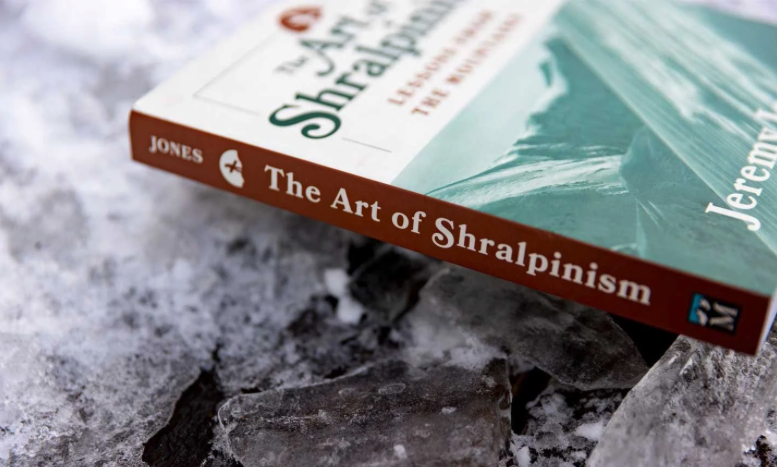
I read this book in 2023 and still retain the dog-eared copy that I received as a gift. Jeremy’s book is full of backcountry wisdom that can also be applied to our daily lives. For those who spend vast amounts of time backcountry skiing and riding, this is a must read. You will enjoy and learn from one of the greatest riders and environmental activists around.
A Few of My Favorite Excerpts…
What I Believe: A Life Manifesto
I believe in karma—If you keep spreading positivity, keep opening doors (not closing them), keep giving more than you take, then hour path in turn will be smoother and happier.
I believe in the power of compounding returns—implementing small things into my life like a simple morning routine done over and over for years on end can lead to major returns.
I believe that whom we surround ourselves with matter—I look for the jazzed, knowledge-seeking, positive people who push my mind and body to think big and go big.
I believe in asking for help.
I believe in mentors, both informal and formal—These are people who have more knowledge than me, people who have been down the road ahead of me. Masters of health, wealth, sport, and science from whom, just by hanging out with them, I learn.
I believe in an “Ode to Progression.”
I believe that fear is the most powerful and detrimental emotion in life and the biggest culprit keeping us from our dreams—For me there are two types of fear: fear of dying, which is good fear; fear of failure, which is bad fear. Understanding the root of your fear and having an intimate relationship with your fear is critical. Fear can keep you alive, but it can also keep you from living.
I believe you only have so many steps on this planet—What are you going to do with them? I choose to use my steps to take me to new places, do new things, and see new landscapes.
I believe that combinations of hard work and doing something more than anyone else in the world will get you 95 percent of the way toward your goals.
I believe there’s no such thing as overnight success.
I believe you’re born into a society that likes to keep everyone on the same path, and there’s very little encouragement to get off that path and forge a new one.
Looking for Opportunity
Embracing the journey is embracing reality and doing with it the most you can. This is essential when dealing with weather and the snowpack…Rather than wasting time on our desperate situation, my mind shifted to “What opportunity does the situation present?” This takes practice starting with very small, positive-focused moments back home. “What’s good right now?”…I shifted my view as soon as it was apparent the entire area we’d been focusing on for months was off the table. There’s usually a great outcome if you train your mind to look for one…
Ego is Not Your Amigo
Ego is one of the most dangerous traits I see in climbers, skiers, snowboarders, mountaineers, and other activities where risk looms. If I see people flexing in the mountains, I avoid them. It’s not just overinflated egos I fear. My own biggest mistakes have come from overconfidence and letting my ego get in the way of protocols and warning signs…Skill is a part of success, obviously, but so is the right mindset and attitude—and keeping egos in check, whether your own or someone else’s, is key.
A Privilege
Is the goal to live in a protected room, making it to one hundred without ever really taking any risks? Or to push is as far as you can, no matter what? Or to come stumbling across the finish line battered and bruised, but still going, with stories and experiences that pushed you to the limits with people and places you love more than anything? It is perhaps the greatest sort of privilege to decide to add risk to your life because it makes you feel alive. Because you can. An insane luxury. We all take up precious resources on this planet; the very least we can do is reach for the stars and appreciate the opportunities we’ve been given. Your life is your own, often with a great deal of responsibility and demands, but living for some cushy future or not pursuing your dreams creates loads of problems as well.
Is this the key to a happy, long life? Creating strong, loving bonds with people close to you? Getting joy out of simpler things? Life is precious, life is fragile. We all die, but do we all live?
My “Live to Ride Another Day” List
1. Live to ride another day. Maybe you didn’t get the line you wanted or just weren’t feeling the flow. Forget about it and come home safe. There’s always tomorrow.
2. Don’t take an agenda into the mountains. Ride what the mountain gives you and don’t force it. The mountains dictate what’s rideable, and it changes every day.
3. Listen to your gut. Don’t let outside pressures cloud your vision. Your gut always knows; you just need to listen.
4. Don’t rush things—slow down. Haste is very dangerous and causes most accidents.
5. Respect every line. Often it’s the mellow, moderate line where bad things happen, because you let your guard down.
6. One mistake is too many. A lifetime of good calls is easily erased by one bad call.
7. Triple-check every line. Go over a line in your head (as well as with photos) over and over and over again, so that once you drop in, you can be totally confident of where you’re going.
8. Expect it to slide. Even though you have determined a line is safe to ride, always have a plan in case it does slide. Know your exits.
9. Pay extra attention to outruns. Outruns dictate how fast you can ride a line. Many times someone rips a line, only to hurt themselves falling into old avy debris in the outrun.
10. Just say no. Whether it’s friends charging you on or a heli circling above with filmers, if it doesn’t feel right—for any reason, at any time—don’t go.
11. Do whatever it takes to get a view of your line. Climb a tree or hike far down a ridge if necessary to get a better view of a line. Know where you’re going!
12. Avoid cornices. Cornices kill. One of the greatest hazards in the mountains.
13. Respect no-fall zones. Avoid them as much as possible. Know where you can risk a fall.
The Right Mindset
We take what the mountains give us—keep expectations loose, travel light, eyes wide open. Be humble. No walls, no boundaries. Open up, set your imagination free, dream big and get moving. But how do we organize and think about this risk so that we can get out there? What are the initial steps? First, start with the right mindset. Walking into the mountains is walking into a world that does not care who you are, what your plans are, or how much training you have. Mountains don’t tolerate ego; it is the single biggest trap…Mindset is the most controllable, useful tool we have. It is also the most trainable—a before, during and after program…Turn off and tune in…At the root of almost every mistake I’ve ever made is mind-drift, an agenda based upon preconceived assumptions, or an inflated ego that clouded my judgement.
Dissecting mistakes is where the real learning begins. Mistakes are equal parts tactical and mental. Being honest and asking what mindset I was in when I made a mistake, broke protocol, missed signs, or chose a poor line is a simple way to greatly improve safety and success. There are three ways to avoid the traps that most often lead to mistakes:
Be present. “Mountains speak, wise men listen,” John Muir said. The mountains demand your full attention. If you aren’t present, you miss signs that keep you alive.
Have patience. Throw the calendar out the window. You cannot force a summit or descent. You cannot make decisions simple based on “It’s the last day or my trip, I’ve worked really hard, weather’s moving in, so now’s the time.” The mountains don’t care. They are ready on their own terms. Always listen and be ready to bail.
Just say no. The goal is to live to ride another day. I repeat this mantra over and over. Realize today might not be the day, and it’s okey to say no. Be present enough to make these calls. Don’t get too emotionally attached to an objective. Avoid summit fever. Celebrate backing down.
In a recent class with Jackson Hole’s Zahan Billimoria—one of the most scientific snow-nerd guides out there—he laid it down: “What we’re doing is basically witch-craft. We’ll look back at this time ten, twenty years from now and shake our heads at how we evaluated the mountain and the risks we took.” Recognizing that our current mountain protocols are the best we have but that we can always improve is crucial. The goal is to safely ride mountains, not get caught in avalanches, and to come home every day. Most of the time we do, but forecasters, patrollers, expert skiers, guides, and veteran rider die every year. We do not have this all figured out! A growth mindset is a must.
The most important question to ask yourself is, “What happens if this slope slides?” Be honest with your answer. Would you stake your life on your knowledge?
Listen to your gut: it is the best and last line of defense. “It just doesn’t feel right” is enough reason to turn around.
What is art? Painting, photography, sculpture, music? My dad is an artist who paints every day, not for money but because of how the process makes him feel. “Get on the other side of your brain and let it take you for a ride,” he likes to say. Art and writing have always been a part of my life—not for the end result but for the process, for the exercise sketching and writing give my mind, for how they complement my physical life in the mountains. To light up the creative side of my brain.
The benefits are unquantifiable, but I make my finest art with a snowboard on a blank white canvas, a life of glide. Like art, there’s no right or wrong way to put the track on a mountain. Art is the stuff that happens once all of the observations, data, science, and experience play out. Art is simple, dynamic, endless possibility. Art is becoming flow ready and embracing your super powers. Art is raising shredders, finding inspiration in nature, and working to protect our winters. Art is the creativity that comes when you lose yourself to what you’ve been dreaming about and living for.
This is what I want to focus on: life is ultra-short, so chase your dreams. The size of your closet does not matter. Happiness is the goal! It’s important to acknowledge that life is precious. We take up resources on this planet, and we should honor it by enjoying every day. I have some advice: work, seek, find joy, and define success for yourself.
It’s important to ask the question, What does success look like for me? Is it a house on the lake and a private jet? It is helping those in need? Helping the planet? It is a life of adventure? There’s no wrong answer here. Asking the question is what’s important. Discovering the answer is your job.
Whatever your answer is, I’ve got some news for you. It’s going to be hard, really hard. Nothing extraordinary happens without hard work. The more unorthodox your dreams, the more conviction and commitment and creativity you will need. The road is lined with critics, doubters, and naysayers telling you to get back in line or to try something else.
Follow your heart. Follow the passion. Go all in. Put your head down for ten years and see where it gets you; that is a good start. Outwork everyone. Put yourself where you want to be. Regardless of your skill level, by doing it more than anyone else is in the world, you will be better than 90 percent of the people out there. If you do not know your destiny yet, relax. It’s okay. Explore, seek knowledge, discover, have an open mind, learn, fail, evolve. Discover is an awesome job! Stagnation is not an option.
In closing, I offer the main tenets of the Church of the Seven Day Recreationalists, as shared with me from one of my main mentors, Jim Zellers:
1. Get outside every day.
2. Keep your house/life in order.
3. Don’t let #2 get in the way of #1.