The Mindful Athlete
By George Mumford
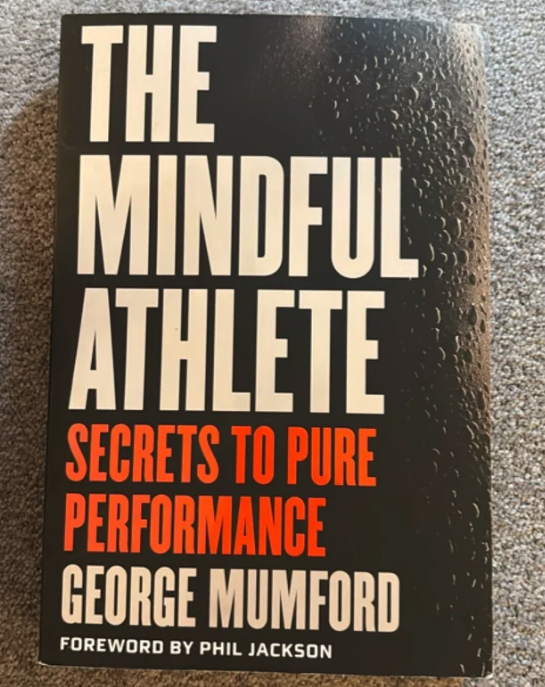
As an athlete I have always been drawn to ways to improve my performance in whatever activity that I am pursuing. In this quest, I came upon George’s work using mindfulness with such greats as Kobe Bryant, Michael Jordan, and others to help them perform at their best. I found the book full of great insights that go beyond just athletic performance. It is a recommended read for those on a journey to live and perform to the best of their ability.
A few of my favorite excerpts…
The Five Superpowers are mindfulness, concentration, insight, right effort, and trust.
· Mindfulness: Being fully present and aware of the "eye of the hurricane"—a calm center amidst external chaos.
· Concentration: Developing focused awareness, often through breath regulation, to stay anchored in the current moment.
· Insight: Cultivating self-understanding to recognize habits and beliefs that may be limiting one's potential.
· Right Effort: Finding a balance between striving for excellence and letting go of self-importance or the need to control every outcome.
· Trust: Having the confidence to step into the unknown and believing in one's own abilities to handle unforeseen challenges.
Life is all about the stimulus that we experience in the world and the way we interpret that in our minds. We can react to this stimulus in various knee-jerk ways—with anger, agitation, anxiety, fear, craving, doubt, guilt—or we can respond to this stimulus by getting still, paying attention “on purpose” to what thoughts and feelings come up within ourselves without judgment, and by acting from this center space of calm. The former way of being will keep us stuck in the same place. The latter way of being, as (Victor) Frankl suggests, will lead us on a path to personal transformation, freedom, and flow.
When you focus on the totality of the present moment, you become aware that there are positive elements in that moment as well as painful ones.
“What you habitually think largely determines what you will ultimately become,” Lee said in his book Letters of the Dragon, introducing the idea that our minds drive not only our performance but also our sense of self and the reality we create for ourselves.
Sit down, clear your mind, and ask yourself in silence: What do I really want? What is my life for? Intention will emerge if you go deep enough. Nearly every single elite athlete or successful individual I’ve worked with had intention and a clear sense of purpose. They knew their charter, their reason for existence.
Let me restate that high performance is less about physical attributes and more about what you bring to the table when you commit to deliberate practice.
Mindfulness helps us stay in the present moment, focused on our purpose. When distractions or self-talk get in the way—whether it’s “my body hurts, or I’m done doing this” or “I’m bored out of my mind” or any variation on that kind of a theme—mindfulness helps you look at those feelings with nonattachment, release them, and return your focus to the present moment and your deliberate practice: doing your thing consciously and with intention, no matter what comes up in your mind, over and over again.
This is a principle in sports and in life: if you get too comfortable in life, you don’t grow…The thing is, if you’re comfortable, and you just want to stay that way, that’s fine. But if you want to pursue excellence and high performance, then you have to be willing to get uncomfortable.
Love it or not, to learn, you’ve got to take risks and stretch yourself. You’ve got to romance the unknown and concentrate on pushing the envelope so that you can attain new skill sets and more readily access flow even under the most trying circumstances.
Mahatma Gandhi once said, “Your beliefs become your thoughts; your thoughts become your words; your words become your actions; your actions become your habits; your habits become your values; and your values become your destiny.” The mystic Edgar Cayce said the same thing this way: “The spirit is the life, mind is builder, and the physical is the result.” And Henry Ford bottom-lined it in his own way when he declared that if you believe that you can or can’t, you are right.
The First Noble Truth is that suffering is a part of life and that life is stressful. That said, we can choose how we react to stress: insight and mindfulness are the ultimate stress reducers. This is good to know, because when we’re stressed, whether it’s physical or emotional, we can’t perform or succeed. The challenge is finding the root cause of our stress. The Second Noble Truth is that there’s a cause for that suffering. Usually these causes are expressed through cravings, attachments, and unwholesome emotional mindsets. The Third Noble Truth is that there is an end of suffering. Well-being comes through practicing non-greed, non-hatred, and non-delusion. For me, this is all part of self-knowledge, wisdom, and understanding because it’s saying that with insight and understanding, we not only get beyond the current manifestation of our suffering or stress; we can actually move way beyond it to a state of wellness, happiness, and joy. The Fourth Noble Truth is the Noble Eightfold Path. The Eightfold Path is the way that leads from suffering, which is the First Noble Truth, to well-being, which is the Third Noble Truth. The elements of the Noble Path are: Right Understanding (Insight), Right Thinking, Right Speech, Right Action, Right Livelihood, Right Diligence (Right Effort), Right Mindfulness, and Right Concentration. The elements of the path are interconnected and affect each other. As you can see, five elements of the path are the Five Superpowers.
If you’re anxious, then it probably means you need to get busy developing new skills. If you’re bored, you’ve got to challenge yourself more and push yourself out of your comfort zone. We need to be wary of being on a plateau and not moving on to the next vista because we’re daunted by the path it takes to get there, or because we’re simply comforted by having reached a plateau. Again, pressure can be good and some people thrive on it. But in order to truly thrive, you have to know your mind and body. To pursue excellence and wisdom, you’ve got to continually move out of your comfort zone and persistently push the envelope with intention; you have to visualize the goal that matches this intention while you do this; and you have to establish your intention and believe it, see it, and then move forward incrementally to manifest the goal, setting your own standards rather than following the herd.
Self-efficacy, or stress hardiness, is the galvanizing force behind what I call the three Cs: Commitment to your growth and development; Control over how you respond to stressors; and viewing every crisis or pressure as a Challenge. These three Cs are mental and emotional pillars of wisdom that help us increase our performance, effectively field whatever fastball might come hurtling our way, and stay in flow. When you combine the three Cs with self-efficacy, you not only see crises as opportunities for growth, you also naturally create challenging goals for yourself that support that growth. This keeps you in a high state of awareness, which means that you naturally push yourself incrementally out of your comfort zone.
Here’s the reframing that has to happen for all of us: We need to recognize failures as opportunities and mistakes as feedback for learning. We need to realize that, like moving out of our comfort zones, failures are potent Challenges for personal growth, as well as opportunities to Control how you respond to challenges and how you keep your Commitment to growth, no matter what. And, by the way, when you move out of your comfort zone, you’re bound to “fail”—but with the right mindset, you are always “failing up.”
Remember what Bruce Lee said: “As you think, so shall you become.” Seven words of wisdom to keep in your back pocket.
You either move forward with intention, or you don’t. There’s no in-between. You do—or you do not. You keep your intentions good and strong. That is right effort—even if you fail.
Right motivation is connected to right effort. It’s motivation that comes from inside, not from external forces. It’s important to ask yourself, “What do I really want?” Start by being aware of your feelings—sometimes we’re not even aware that we have feelings! Investigating your feelings helps you to see your motivation more clearly, as well as to see whether it is right motivation or not.
If you stay focused on tearing something down instead of building it up, you won’t end up feeling great because you’ll simply be consumed by hatred, anger, contempt, or other emotions that lead to distress.
The real question is this: Can you bring into your life, both on and off the court, the love of the game, the love of being present, the love of being all that you can be, the love of being of service, the love of taking your humanity to another level?
This is right effort, and it’s the engine that drives the pursuit of excellence. When your actions are based on right effort, you cultivate an entirely different energy; rather than acting out of greed, or doing things strictly for yourself or from self-interest, you act for selfless reasons and thus generate more energy and opportunity for flow. Because as long as there’s a self there, as long as your ego-mind is focused on how you’re doing instead of what you’re doing, you’re operating out of self-consciousness. This mindset generates insecurity, takes you out of the present moment, and makes it more difficult to get in touch with that still and powerful center space between stimulus and response where, as Bruce Lee says, you can “be like water.”
You can’t keep what’s happening from happening. But you can choose how to respond. You can react and get the sympathetic nervous system riled up and flood your body with stress hormones that impede your game. Or you can sit back, breathe, observe what’s happening, and respond to what is, rather than what you think should be, could have been, or was supposed to be. “Okay, so this is happening instead of that. Wow, well, I need to change course and find a new path out of this situation.”
Again, this is like being fluid like water, not rigid like ice. It’s about responding to the flow of life around us rather than reacting, because responding facilitates flow; reacting obstructs it.