Anasazi America
By David E. Stuart
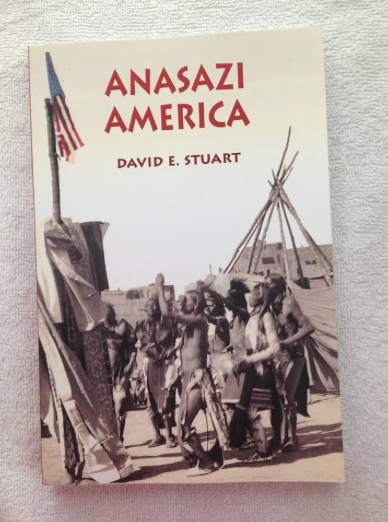
In a discussion with a friend about the current state of affairs in the United States, this book was recommended to me. Having lived in the Southwest U.S. for nearly 20 years, I have an interest in the history of the region and the people who called the place home long before us. I have spent countless hours exploring and walking in the footsteps of those of the past, seeking to understand how they lived. Central to the allure of the Southwest is the many cultural sites that engage the imagination causing a sense of wonder to arise. Though written in the late 1990’s, Stuart’s description of the rise and fall of the Chacoan society is eerily parallel to that of the United States. It is prophetic. I highly recommend this book to those who have an interest in the history of the southwest and seek to learn from the mistakes of those who came before us.
A few of my favorite Excerpts…
…Nervously, I described the failure of the Chacoans to change course and adapt in order to avert the collapse of the impressive regional society they had created in the tenth and eleventh centuries. Foremost among Chacoan problems were misuse of farmland, the desperate economic and nutritional status of small farmers, the loss of community, and an inability to deal with climatological catastrophe. The parallels to modern America seemed obvious.
…Similarly, a powerful society (or organism) captures more energy and expends (metabolizes) it more rapidly than an efficient one. Such societies tend to be structurally more complex, more wasteful of energy, more competitive, and faster paced than an efficient one. Think of modern urban America as powerful, and you will get the picture. In contrast, an efficient society “metabolizes” its energy more slowly, and so it is structurally less complex, less wasteful, less competitive, and slower paced. Think of Amish farmers in Pennsylvania or contemporary Pueblo farmers in the American Southwest.
In competitive terms, the powerful society has an enormous short-term advantage over the efficient one if enough energy is naturally available to “feed” it, or if its technology and trade can bring in energy rapidly enough to sustain it. But when energy (food, fuel resources) becomes scarce, or when trade and technology fail, an efficient society is advantageous because its simpler, less wasteful structure is much more easily sustained in times of scarcity. Since both “power” and “efficiency” offer enormous advantages under the right circumstances, most human societies are engaged in a constant and complex balancing act between the two. Being human, we want it both ways.
Growth models, albeit on a much grander scale, are familiar to all of us in contemporary society. Much of modern Western economic theory is based on the unabashed growth model formulated by John Maynard Keynes. We rarely even question the underlying means of growth and progress in contemporary society.
Rapid expansion of economic production and increasing competition are the classic conditions that have led to episodes of economic collapse and financial panic in modern times.
As America matures, it must work at the art of survival if it is to be the model of prosperity, democracy, and stability a century from now that it is today. The model of historic Pueblo society – efficient, egalitarian, homogeneous, and self-sufficient – is not one we can or should mimic in detail. The U.S. is far too large, heterogeneous, polyglot, and growth-oriented to justify such mimicry…But the means of Pueblo success at survival points the way toward some essential improvements.
First, we can no longer accept the troubling fact that the U.S. is actually “number one” among industrial nations only in the sheer size of its economy and in the disparity of wealth between citizens. America has been so obsessed with its short-term power that it has forgotten the long-term value of efficiency. We must become more efficient and less wasteful. Americans use more than twice as much energy per person as citizens of the other rich, industrial nations of Europe. Their standards of health, education, public transportation, infant mortality, longevity, and literacy are generally higher than ours.
And we must rethink our national tax policies. Is it sensible that a disproportionate share of our nation’s taxes are paid by the shrinking American middle class? For that matter, why are American corporations taxed less than their counterparts in other industrial nations?...Or does it make more sense to tax corporations and the growing numbers of the ultra-rich just a little more in order to guarantee all our citizens a reasonable level of health care, good schools, and public transport?
The themes of this book are transformation and survival. The marketplace’s question “Can you buy it cheaper today than yesterday?” needs to be transformed into “If it is essential to survival, can you get it today, tomorrow, and forever?” The Chacoans did not fail because they ran short of turquoise and macaws, which they prized. They failed because they ran out of essentials, so that their growth could not be sustained. At the end, they did not have enough water, corn, meat, or fuel. If modern societies fail, ours included, it will not be because they taxed widgets another 3 percent to create infrastructure or because they could import fewer Mercedes sedans. It will be either because, besotted by the idea of growth, they ran out of irreplaceable resources – fossil fuel, water, farmland – or because they so flamboyantly increased the disparity in wealth that the moderating middle class vanished and cities burned in an orgy of rage and desperation. Both scenarios are preventable.
Can we again have a national community with shared values? Yes – if we can learn to share more than just a lecture about values. America works surprisingly well, considering the chances we have taken with our resources and our social order. That luck cannot last forever. The old idea of a strong public American identity based on common language, tolerance, flag, and fair play still has merit. Most immigrants to this nation still want a real chance at that identity. They want a share, not a lecture. So do the descendants of America’s former slaves.
We can waste less. We can re-create safe and satisfying communities that Puebloan society would understand. They would be communities where all who worked hard and believed in the community were guaranteed a place – a place to live, a place to marry, a place to raise children, and a place to die, secure in the knowledge that their children’s children would enjoy the same. But to have a community requires us to work at it, to invest in it, and to think strategically rather than just about the near term. We must now build our own version of a durable community and invest far more heavily in survival than we have so far been willing to do. That means we must support a robust middle class and again build infrastructure designed to last a century rather than a decade. It will not be easy. But it must be done.
We can start by accepting the lesson left to all of us by the Anasazi of Chaco Canyon and their adaptable descendants – that survival means establishing a durable community. A durable community is one that balances growth with efficiency and refuses to be seduced by greed and power. Even the business world, currently astray on its own path to short-term profits, knows this. On Wall Street, veterans of the business cycle know that “bulls get rich, bears get rich, pigs get slaughtered.” As the Chacoans, too, discovered nearly a millennium ago, greed is not a badge of honor. It is the signature of a dying society.