Master of Change
By Brad Stulberg
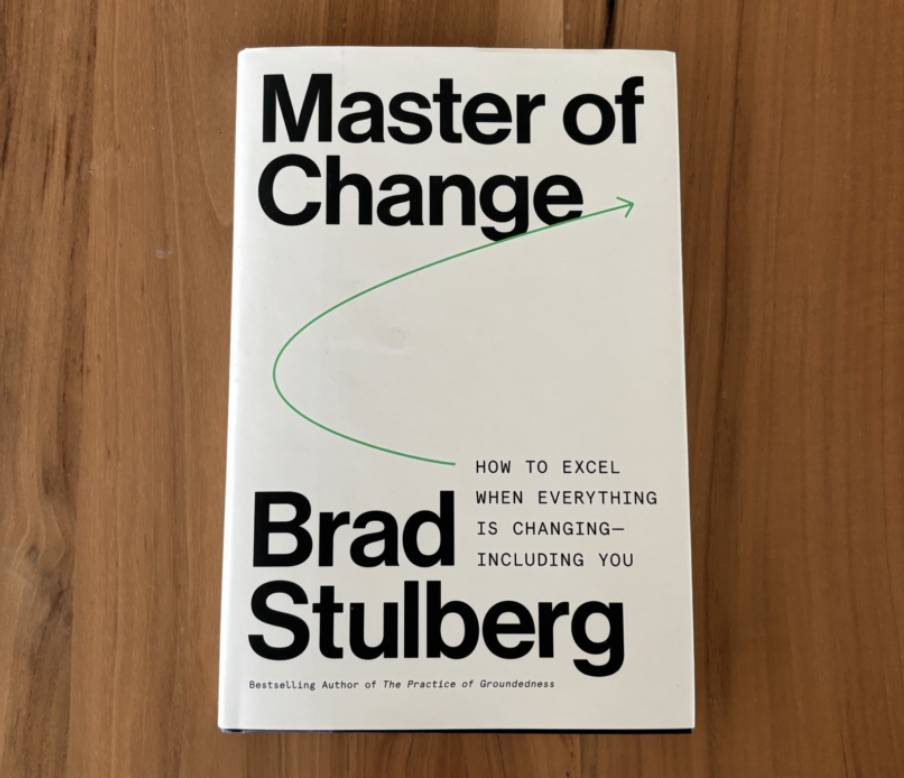
I’ve always been interested in self-improvement literature. I read this book as I began to think about my approaching retirement and the consequent change that would happen in my life as a result. Brad’s book provides a framework for embracing change and the uncertainty that it brings. I found it to be a worthy read.
A Few of My Favorite Excerpts…
Demagogues, authoritarians, and grifters thrive during periods of disorder. They offer a false sense of status and security to those who dislike or feel threatened by what is happening. They represent the past, fighting to go back to the way things were instead of moving forward toward something better.
Pursuits that align with your core values and shrink a big, unwieldy, and overwhelming world to make it feel smaller and more manageable are useful for integrating significant changes into your life and walking confidently into the unknown.
When you operate in having mode, you define yourself by what you have. This makes you fragile because those objects and attributes can be taken away at any given time. “Because I can lose what I have, I am necessarily constantly worried that I shall lose what I have. . . . I am afraid of love, of freedom, of growth, of change, and of the unknown,” writes Fromm.
When you operate in being mode, however, you identify with a deeper part of yourself: your essence and core values, your ability to respond to circumstances, whatever they may be. A having orientation is static and intolerant to change. A being orientation is dynamic and open to change.
Swaths of psychological research show that our happiness in any given moment is a function of our reality minus our expectations…When reality matches or exceeds expectations, we feel good. When reality falls short of expectations, we feel bad.
First, a definition: tragic optimism is the ability to maintain hope and find meaning in life despite its inescapable pain, loss, and suffering. It is about acknowledging, accepting, and expecting that life will contain hardship, that sometimes impermanence hurts, and then trudging forward with a positive attitude nonetheless.
Research shows that individuals who face life with a mindset of tragic optimism—in particular, those who expect a fair share of change and hardship—have advantageous physical and psychological responses to stress. They feel less pain, gain more fortitude, and are more likely to successfully move forward following disruption.
Suffering is not the same thing as pain: suffering equals pain times resistance…Happiness equals reality minus expectations, and suffering equals pain times resistance.
The two core components of a rugged and flexible mindset work together. First, we’ve got to drop the weight of denial and resistance and instead open to the flow of life, accepting that the only constant is change and seeing it clearly for what it is. Second, we’ve got to expect it to be hard, which, paradoxically, makes everything easier.
Happiness at any given moment is a function of your reality minus your expectations. Our culture pushes us to wear rose-tinted glasses and “think positive,” but we have a better chance at feeling and doing good if we set realistic expectations—including that things change all the time, sometimes for better and sometimes for worse. Our brains are constantly trying to predict what will happen next and then align those predictions with reality—when our predictions are off, we benefit from updating them as swiftly as we can. There are numerous advantages to cultivating an outlook of tragic optimism, realizing that life contains inevitable pain and suffering yet moving forward with grace and grit nonetheless. When confronted with significant challenges, instead of being a Pollyanna or wallowing in despair and nihilism, both of which are maladaptive, do what you can to commit to wise hope and wise action. Like it or not, this is what is happening right now; I am going to focus on what I can control, do the best I can, and come out the other side. Suffering equals pain times resistance; the more you can shed your resistance, the exponentially better you’ll feel and do.
It seems that all true things must change and only that which changes remains true. – Carl Jung
Even (and perhaps especially) if we don’t know where the path ahead is going, we’d be wise to adopt an attitude of simply doing the next right (i.e., values-driven) thing. This gives us the best chance of getting where we ought to go. Developing rugged flexibility is anything but passive. Taking thoughtful and deliberate actions is what being in conversation with change is all about—Your core values are the principles by which you live; they serve as the rugged boundaries of your identity, guiding how you differentiate, integrate, and navigate your path. It is good to have three to five core values. Define each in specific terms and come up with a few ways you can practice each in day-to-day life. When you feel the ground shifting underneath you, when you don’t know your next move, you can ask yourself, How might I move in the direction of my core values? Or, if that isn’t possible, you might consider, how might I protect them? Flexibility is about continually adjusting how you practice and apply your core values in ways that are true to yourself but also in harmony with your changing circumstances.
Reacting is quick. You feel and then do. Responding is slower. It involves more space between an event and what you do, or don’t do, about it. In that space, a pause, you give immediate emotions room to breathe and thus you come to better understand what is happening—that is, you process. As a result, you can reflect and strategize using the most evolved and uniquely human parts of your brain to make a plan that is in alignment with your values, and then proceed accordingly. Responding is harder than reacting, especially at first. It requires more psychic energy; it demands letting an urge to immediately do something, anything, be there without giving in.
Respond not react during periods of change and disorder, separate what you cannot control from what you can, and then focus on the latter while trying not to waste time and energy on the former. Becoming fixated on any given path or outcome often yields suboptimal results; instead, work on developing zanshin, or a broader, more curious, and more inclusive awareness. The best way to shift from the RAGE pathway and reacting to the SEEKING pathway and responding is by practicing the 4Ps: Pause by labeling your emotions Process by practicing non-identification, viewing your situation with remove Plan by self-distancing and gaining even greater perspective as you evaluate your options. Proceed by taking micro-steps, treating each as an experiment and adjusting as you go.
Five Questions and Ten Tools for Embracing Change and Developing Rugged Flexibility:
Where in your life are you pursuing fixity where it might be beneficial to open yourself to the possibility—or in some cases, the inevitability—of change?
In what parts of your life are you holding on to unrealistic expectations?
Are there elements of your identity to which you cling too tightly?
How might you use your core values—the rugged and flexible boundaries of your identity—to help you navigate the challenges in your life?
In what circumstances do you tend to react when you would benefit from responding, and what conditions predispose you to that?